
Signs of a downspout or drainage problem
Downspout trouble shows up at the bottom of the wall more often than at the top. Look for:
- Water gushing over the gutter above a downspout while the downspout itself runs dry or dribbles.
- Water leaking from the downspout's seams or elbows, a sign it's full and backed up.
- A hole or trench in the soil where the downspout lets out.
- Puddles against the foundation after rain, or a damp patch on the basement wall near a corner.
- Soil that has settled and now slopes toward the house at a downspout.
- A crushed bottom elbow (lawn mowers and car bumpers do this) or an extension lying in the yard, disconnected.
- Water bubbling up where a downspout enters a pipe in the ground.
- Ice sheets on the driveway or sidewalk in winter where a downspout empties across it.
What causes downspouts to fail
Clogs form at the elbows, where the pipe bends and debris wedges. A standard 2x3-inch downspout has a small opening, and one clump of wet leaves or a tennis ball is enough to plug it. Physical damage is the next most common cause: the bottom elbow and extension are at ground level and get stepped on, hit and removed for mowing.
The third cause is design. Many houses were built with too few downspouts or with downspouts that end at a splash block 6 inches from the wall.
What downspout repair and installation involves
Clearing and repairing existing downspouts
We flush from the top, and if the clog doesn't move we take the elbows apart and clear it by hand. Crushed elbows and split sections are replaced. Loose downspouts are restrapped to the wall, and joints are refastened so the upper piece always sits inside the lower one and water can't leak out at the seam.
Adding or upsizing downspouts
If a gutter run overflows when clean, it usually needs more outlet capacity. We cut in a new outlet and add a downspout, or replace 2x3-inch downspouts with 3x4-inch.
On a long run, adding a downspout at the far end and pitching the gutter both ways from the middle is often the fix. This sometimes goes with re-pitching the gutter.
Extensions and buried drain lines
Every downspout needs to discharge well away from the wall. The options, from simplest up:
- Rigid aluminum extensions matched to the downspout, some hinged so they flip up for mowing.
- Buried solid pipe running to a pop-up emitter in the lawn, which keeps the yard clear and carries water much farther.
- Rerouting a downspout to a different corner where the grade is better.
For buried lines we check the slope of the yard first. The pipe has to fall the whole way, and the outlet has to be somewhere the water can spread out without running onto a neighbor's lot or across a sidewalk.
Connecting a downspout to a rain barrel or storage tank
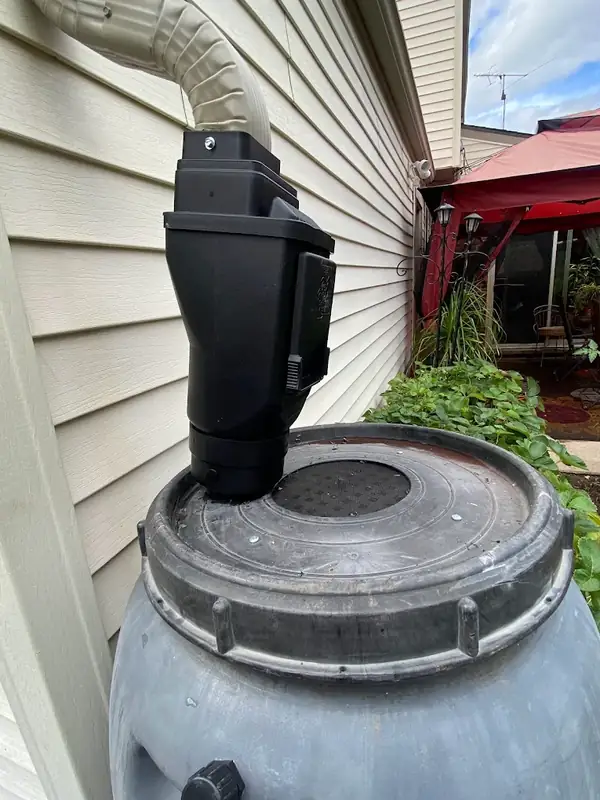
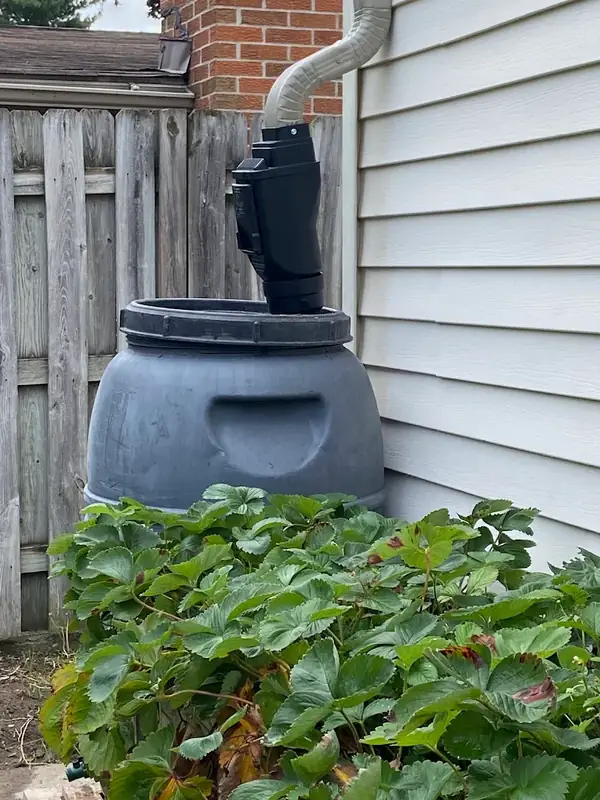
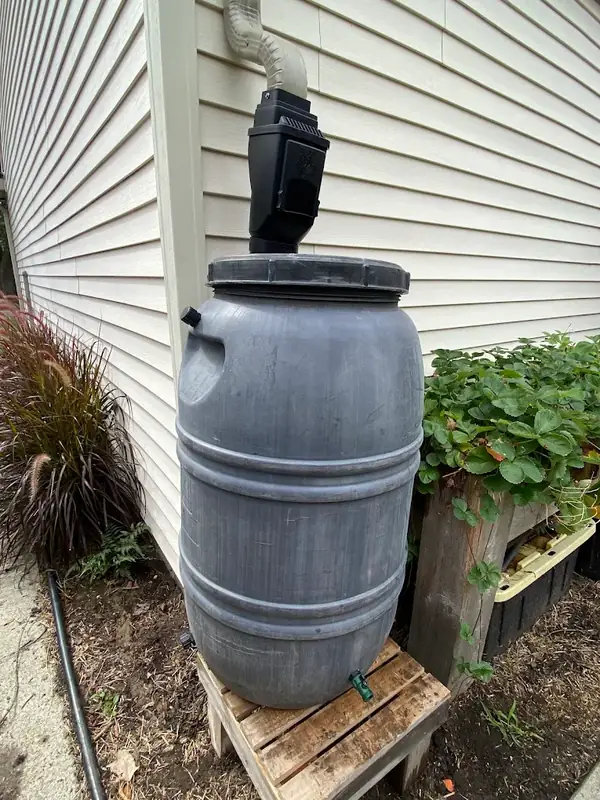
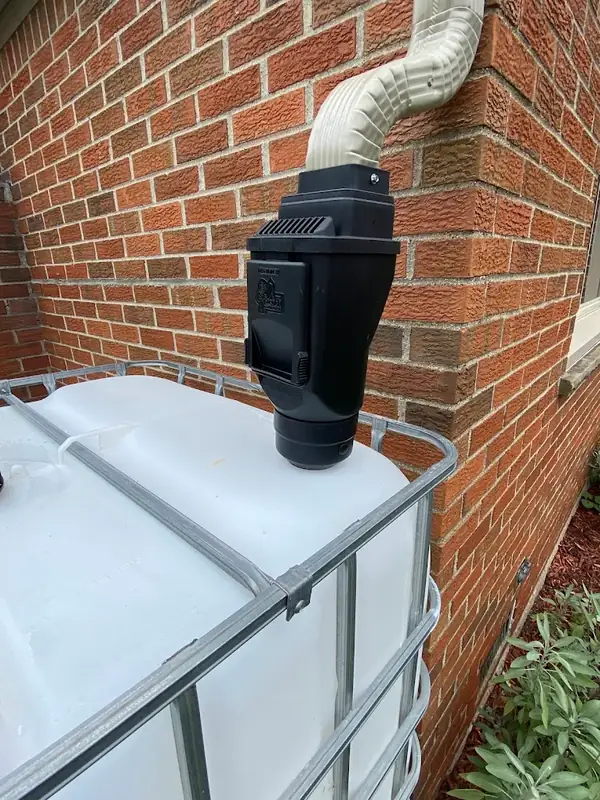
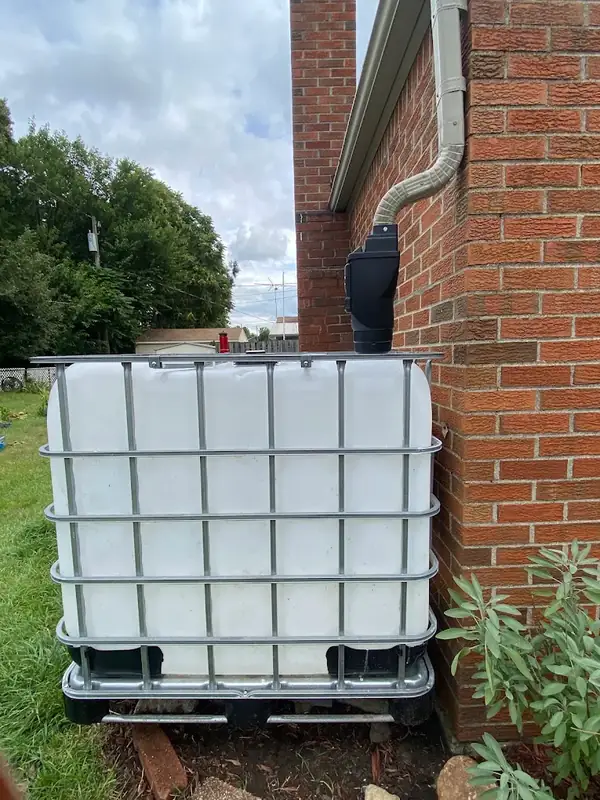
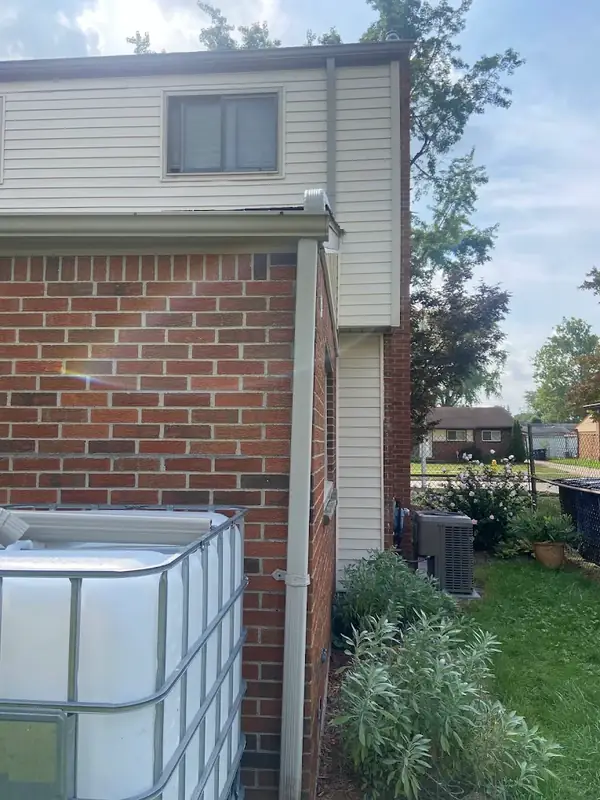
A downspout can feed a rain barrel or a larger tank so roof water is saved for the garden. It works well when 3 things are handled properly.
- Filtering. A filter or diverter box at the end of the downspout screens out leaves and shingle grit before the water enters the container.
- Overflow. A barrel fills fast. An inch of rain on even a small section of roof is more than a 55-gallon barrel holds. Once it's full, the extra water needs a planned route away from the foundation, or you have put the downspout problem right back at the wall.
- Winter. Water left in a barrel or its fittings freezes and splits them. In Michigan the container should be drained and disconnected before hard freezes, and the downspout put back on a normal extension until spring.
The container also needs a firm, level base. A full barrel weighs several hundred pounds, and a full caged tote weighs more than a ton.
Why downspout discharge matters so much for Pontiac basements
Many of Pontiac's older houses were built over full basements, and a large share of the city's housing went up before 1970, before modern foundation waterproofing and drainage boards were standard. Those basement walls depend heavily on the soil around them staying reasonably dry.
Now consider the roof. An inch of rain on a modest house puts several hundred gallons of water into the gutters, and all of it comes out at 3 or 4 downspouts. June is typically Pontiac's wettest month, with storms that deliver that inch quickly.
If a downspout ends at the wall, those gallons soak in right beside the basement, storm after storm. The result is the damp corner, the white mineral crust on the block, or the trickle across the floor that many homeowners assume is a foundation defect. But very often it's a downspout problem, and extending the discharge is the least expensive basement fix there is.
On pre-war homes we also find downspouts that drop into old clay tile lines in the ground. Many of those lines are cracked or root-filled after a century. If water backs up at the connection, the line is done, and the downspout should be rerouted.
What affects the cost of downspout and drainage work
- Repair or replace. Clearing a clog and replacing an elbow is a small job. New downspouts on every corner is more.
- Height of the house, which sets the length of each downspout.
- Size. 3x4-inch material costs more than 2x3-inch and needs a larger outlet cut into the gutter.
- Extension type. Above-ground extensions cost little. Buried lines are priced by length and by what has to be dug through.
- Obstacles. Sidewalks, driveways, patios, tree roots and utility lines along the route. Underground utilities must be marked before any digging.
- Related gutter work, such as re-pitching a run to feed a new downspout.
When a downspout problem is an emergency
Treat it as urgent when:
- Water is coming into the basement during a storm and a downspout is clogged, disconnected or emptying at the wall
- A downspout has pulled off the upper wall and is swinging or hanging
- A blocked downspout is making the gutter overflow into a window well, a door or an electrical meter area
- Discharge is freezing into a sheet of ice across steps or a walkway
Call (248) 653-1727 any time. As a stopgap, if you can reach the bottom of the downspout safely from the ground, attaching any length of pipe or even a temporary flexible extension to get the water a few feet farther out will help. More on our emergency gutter repair page.
What to monitor after drainage work
In the next heavy rain, check that each downspout runs hard and that water leaving the extension keeps moving away from the house. If you have a pop-up emitter, make sure it opens and that grass hasn't grown over it. Clear leaf filters at the base of buried lines each fall.
Keep extensions attached. An extension lying in the garage is the most common drainage failure we see.
If the downspouts keep clogging no matter what, the answer may be upstream: more frequent gutter cleaning or guards. For the full picture, see our overview of gutter and downspout services in Pontiac.
Downspout and drainage questions homeowners ask
How far from the house should a downspout discharge?
At least 4 to 6 feet, onto ground that slopes away from the foundation. More is better on flat lots. A splash block alone moves water only a couple of feet, which isn't enough for most homes with basements.
How many downspouts does a house need?
A common rule is one downspout for roughly every 30 to 40 feet of gutter, but roof area matters more than gutter length. A short gutter under a large, steep roof plane or a valley can need its own downspout. We size it from the roof.
Should I upgrade from 2x3 to 3x4 downspouts?
If your downspouts clog often or your gutters overflow in heavy rain, yes. A 3x4-inch downspout has about twice the opening of a 2x3. It moves more water and lets leaves and seed clusters pass that would jam the smaller size.
Can downspouts be connected to an underground drain?
Yes. The downspout connects to solid pipe buried with a steady slope, which carries water to a pop-up emitter or daylight outlet in the yard. The line needs a cleanout or a leaf filter at the downspout so debris doesn't block the pipe underground.
My downspout goes into a pipe in the ground and water backs up. What's wrong?
The buried line is blocked or broken. On older homes these lines are often clay tile that has been crushed or filled with roots. We can disconnect the downspout and route it above ground to an extension, or replace the buried line, depending on the lot.
Is it okay for a downspout to drain onto a lower roof?
It works, but it concentrates water on one strip of shingles and wears them out early. The better practice is to run the upper downspout across the lower roof in pipe and into the lower gutter, or straight to the ground.