
Signs your Pontiac home needs new gutters
New gutters make sense when the old ones have failed in several places at once, or were never the right size. These are the signs we look for:
- A seam every 10 feet, and most of them drip. Older sectional gutters are joined with slip connectors and sealant. Once the sealant fails along the whole run, resealing buys 1 or 2 seasons at best.
- Rust holes or orange streaks on galvanized steel gutters.
- Creases, dents and a wavy front edge from ladders or ice. Bent aluminum doesn't hold its slope.
- Gutters pulling away along most of the house, with spikes sticking out an inch or more.
- Overflow in a hard rain even right after cleaning. The system is undersized or has too few downspouts.
- Peeling paint and dark staining on the fascia behind the full length of the gutter.
- Trenches in the mulch or soil directly under the roof edge, where water has been falling for years.
If the trouble is limited to one corner or one loose section, a gutter repair is usually the better value and we'll tell you so.
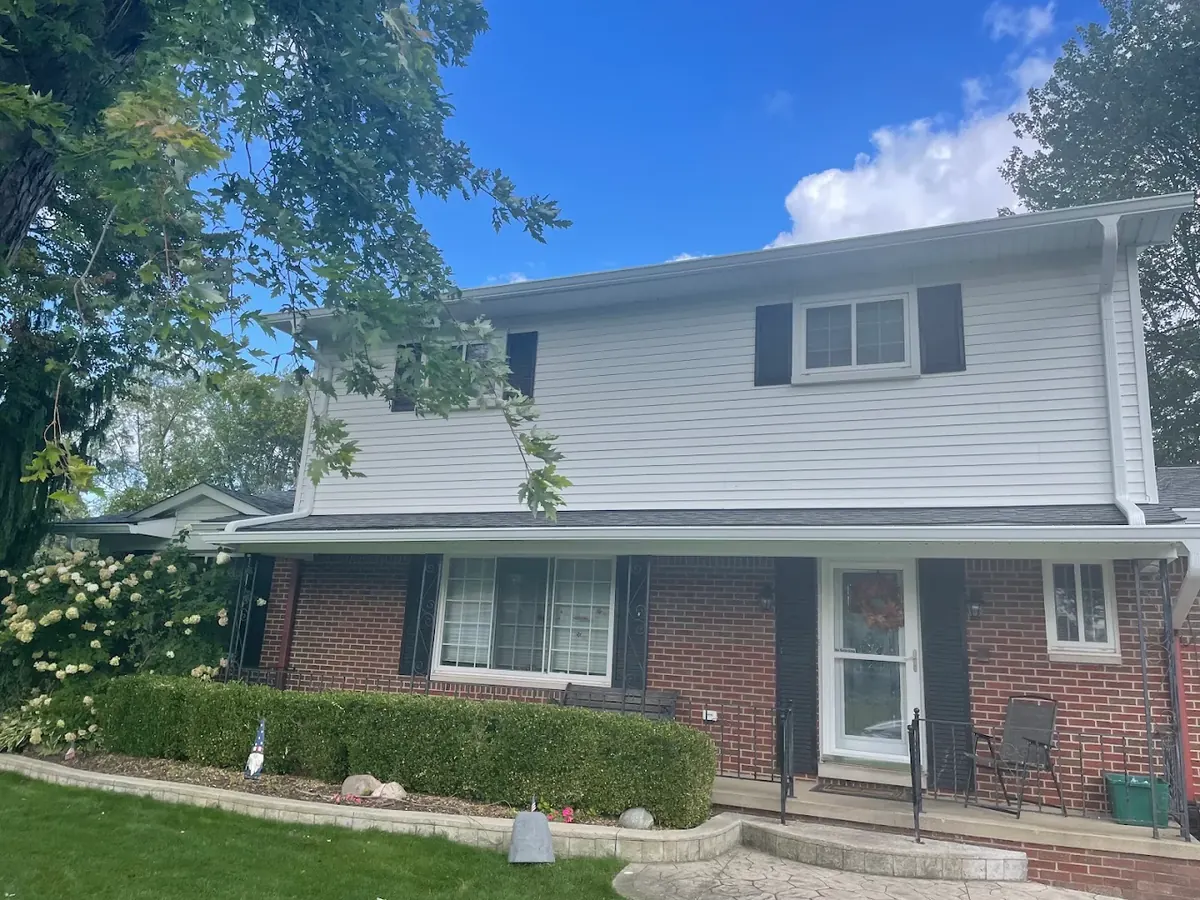
What a seamless gutter installation includes
Here's the sequence on a typical house:
- Measure and plan. We measure each run, note the roof area draining to it, and decide where the downspouts go and which way each run slopes.
- Remove the old gutters. Old sections, spikes and brackets come down and are hauled away.
- Check the wood. With the gutter off we can see the whole fascia board. Soft or rotted sections are replaced before anything new goes up. See fascia and soffit repair.
- Form the gutters on site. A gutter machine shapes flat aluminum coil into K-style gutter, cut to the exact length of each run.
- Hang and pitch. Hidden hangers clip inside the gutter and are screwed through the back into the fascia. Each run is sloped toward its outlet, about a quarter inch for every 10 feet, enough to drain without looking crooked from the street.
- Cut and seal corners. Inside and outside miters and end caps are fitted and sealed with gutter sealant.
- Install downspouts. Outlets are cut in, downspouts are strapped to the wall, and the bottoms get elbows and extensions so water lands away from the foundation.
- Water test and cleanup. We run water through every run, check corners for drips, and pick up scrap and old fasteners.
Gutter sizes and materials we install
Most homes here get 5-inch or 6-inch K-style aluminum. Other options exist for specific houses.
| Option | Best suited to | Worth knowing |
|---|---|---|
| 5-inch K-style aluminum | Most ranches, bungalows and 2-story homes with moderate roof pitch | Pairs with 2x3-inch downspouts. The standard choice. |
| 6-inch K-style aluminum | Steep or large roofs, long runs, valleys, metal roofs | Holds noticeably more water and uses 3x4-inch downspouts that pass leaves more easily. |
| Half-round | Older and historic homes where a period look matters | Hangs on exposed brackets. Carries less water than K-style of the same width, so sizing matters. |
| Copper or steel | Specific architectural styles and owner preference | Higher material cost. Copper weathers to brown and then green and shouldn't touch aluminum. |
Aluminum thickness matters in snow country. Thicker coil resists denting from ladders and holds its shape under ice better than thin builder-grade stock. Ask what gauge is being quoted when you compare prices.
What affects the cost of new gutters
The price of an installation is driven mainly by total footage, the number of corners, and the height of the house. More specifically:
- Linear feet of gutter and downspout. A 2-story home uses about twice the downspout of a ranch.
- Size and material. 6-inch costs more than 5-inch, and copper or steel costs well above aluminum.
- Corners. Miters take the most hand labor on the job.
- Height and access. Second-story work, steep grades, decks, and landscaping under the eave slow the work down.
- Tear-off and disposal of the existing gutters.
- Fascia replacement. We can't know how much wood is bad until the old gutter is off, so this is quoted as a per-foot add if it turns up.
- Extras: drip edge or gutter apron, gutter guards, and extensions or buried lines at the downspouts.
We give you a price after measuring. We don't quote by phone from square footage alone, because the corner count and wood condition change the job too much.
How Pontiac's historic districts affect gutter replacement
If your home is in one of Pontiac's local historic districts (Seminole Hills, Franklin Boulevard, Fairgrove Avenue, or the GM Modern Housing district off Perry Street), exterior work is reviewed by the city's Historic District Commission. The commission issues a Certificate of Appropriateness, and that comes before any building permit.
For gutters, this matters when you change what the house looks like from the street: switching from half-round to K-style, changing the color, moving downspouts onto the front elevation, or covering original wood trim. Many 1920s homes in these districts were built with half-round gutters on brackets or with gutters built into the eave, and the commission will care about keeping that character. Before you sign for a replacement, confirm with the city what review your address needs.
We can lay out profile and color options that fit a period house so you have something concrete to submit. Our Seminole Hills page covers that neighborhood in more detail.
When gutter replacement becomes urgent
New gutters are normally a scheduled job. It moves up the list when:
- A long section has come off and the fascia or rafter tails are exposed to rain
- A run is hanging by a few fasteners above an entry or driveway
- Water is entering the basement every time it rains because the gutters no longer carry anything
In those cases we secure or remove the failed section first, which is covered under emergency gutter repair, then schedule the full install.
How to prepare for installation day and what to watch afterward
Move vehicles out of the driveway so the gutter machine can park close to the house. Clear patio furniture, grills and planters from under the eaves, and let us know about sprinkler heads, invisible dog fences, and anything fragile in the beds. Someone should be reachable by phone in case we find bad wood and need a decision.
After the first heavy rain, walk around the house. Water should be coming out of every downspout and none should be dripping from corners or running behind the gutter.
Check again after the first winter. And new gutters still need cleaning, usually twice a year, unless guards are installed.
Go Gutters handles gutter installation and repair in Pontiac as one trade, so the same company that hangs your gutters can service them later.
Gutter installation questions homeowners ask
How long do seamless aluminum gutters last?
Aluminum doesn't rust, so the metal itself commonly lasts 20 years or more. What shortens the life is physical damage: ladders leaned against the gutter, ice load on a gutter that was hung with too few hangers, and debris left to sit wet for years. Corner sealant is the first thing to age and can be redone without replacing the gutter.
Should I choose 5-inch or 6-inch gutters?
5-inch K-style handles most Pontiac single-family roofs. Choose 6-inch when a long or steep roof plane drains to one run, when 2 roof sections meet in a valley above the gutter, or when the house has a metal roof that sheds water fast. A 6-inch gutter also pairs with a 3x4-inch downspout, which clogs far less often.
Do new gutters have to match my old ones?
No. A full replacement is the time to change size, color, downspout locations or style. If you're replacing only one side of the house, we match the profile and color to what's staying so the house looks consistent.
Do I need a permit to replace gutters in Pontiac?
Permit rules are set by the City of Pontiac and can change, so confirm with the building department before work starts. Homes inside one of Pontiac's local historic districts have an added step: exterior work there goes through the Historic District Commission first. The city's planning office can tell you whether your address is in a district.
Should gutters be replaced before or after a new roof?
After, when possible. Roofers work from the eave and can dent new gutters, and the drip edge that goes on with the new roof determines how the gutter should sit. If the gutters must come first, we set them so the roofer's drip edge can lap into them.
Can you install gutters on a house that has never had them?
Yes. We check that the fascia is straight and solid, plan where downspouts can discharge without sending water onto a walkway or a neighbor's lot, and install drip edge or gutter apron if the roof has none.